Rajpipla State was a princely state, within the Political Agency of Rewa Kantha, Bombay Presidency, lying between latitude 21° 23′ and 21° 59′ north, and between longitude 73° 5′ and 74° east with full internal jurisdiction, in India ruled by the Gohil Rajput dynasty for over 600 years from around 1340 until 1948. It was the largest State, and the only first-class State, of the Rewa Kantha Agency.
The former Rajpipla State lay largely between two major rivers of western India, the Narmada and the Tapti, with the Satpura range to the south. It covered over 1,517 square miles (about 4,000 square kilometres), of which roughly 600 square miles (1,550 square kilometres) were forest, the remainder being fertile plains and river valleys. Over time, Rajpipla became one of the most prosperous princely states in Gujarat, second only to Baroda, and was also noted for its agate mines. The capital town of Nandod was officially renamed Rajpipla in 1947.
 |
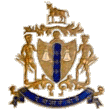
Rajpipla Coat of Arms |
The Arms were granted to Maharana Shri Gambhirsinhji Vairisalji (r. 1860–1897) at the Delhi Durbar of 1877. According to Peter Röver, on 1 January 1877, Queen Victoria conferred Coats of Arms upon 89 Indian rulers; these were designed in London by the College of Arms in consultation with the states concerned.
The shield is divided into three vertical fields: the outer ones each feature a sailing ship, while the central field displays three cannons—the precise heraldic significance of which remains unclear. The supporters depict armed Adivasi Bhils holding bows and arrows, and the crest resembles a stag. The motto, in Hindi script, reads Rewà Jìne Kànthé, referring to the Rewa Kantha district ("On the banks of the holy River Rewa [Narmada]").
 |
Flag of Rajpipla State |
The history of the Rajpipla kingdom traces back to the early 14th century, when Prince Chokrana—a Parmar Rajput heir from Ujjain in Malwa—left his ancestral lands and ventured westward into the wild, hilly tracts of the Satpuras. He established his first capital at Dev Chhatra, where an ancient archway still stands today. From there, Chokrana Parmar ruled, and around 1340, Arjunsinhji Gohil succeeded him.
The capital was shifted lower to Junaraj, on the banks of the Karjan, in the 15th century. This site, surrounded by hills, dense forests, and the deep gorges of the Karjan valley, was strategically more secure. Thereafter it was finally moved to Nandod in 1730.
Chokrana’s daughter married Thakur Mokhdaji Ranoji (1309–1347), the Gohil Rajput chief of Ghogha, whose capital was at Pirambet in the Gulf of Cambay. Their son, Kumar Shri Samarsinhji Mokhdaji Gohil, succeeded to the gadi of Junaraj (Old Rajpipla) on the death of his maternal grandfather Chokrana Parmar, who had no male heir. On his coronation around 1340, Samarsinhji assumed the name Arjunsinhji and became the first Gohil Rajput ruler of Rajpipla.
Mokhdaji’s elder son, Dungarsinhji, born of his first wife, a Sarvaiya princess of Hathasani, succeeded to the gadi of Ghogha in 1347, which later developed into the Bhavnagar State. Though the principality of Rajpipla passed to the Gohil Rajputs, they adopted the Parmar family deity Shri Harsiddhi Mataji of Ujjain as their Kuldevi.
The Gohil Rajput lineage of Rajpipla traces its origin to Muhideosur Gohadit or Guhil, born in 542 A.D., who survived the sack of Vallabhi as the sole male of his clan. In 556 A.D. he became chief of a territory near modern Idar in Gujarat and ruled until his death in 603. His descendant Kalbhoj, better known as Bappa Rawal, captured Chittor and became ruler of Mewar in 734 A.D.
Around 973 A.D., Salivahan, the Gohil ruler of Mewar and the eleventh in descent from Bappa Rawal, left Chittor with part of the clan and settled at Juna Khergarh (modern Bhalotra near Jodhpur) on the Luni river in Marwar, leaving his son Shaktikumar with the rest of the family in Mewar. A village near Jodhpur still bears the name “Gohilon ki dhani”, reflecting this settlement. For roughly two and a quarter centuries thereafter, both Mewar and Marwar were under Gohil Rajput rule.
After Ala-ud-din Khilji’s sack of Chittor in 1303, the Gohils of Mewar regrouped and became known as Sisodias, later shifting their capital from Chittor to Udaipur in 1559. Meanwhile, the Gohils established by Salivahan in Marwar continued to rule there until the arrival of the Rathores, who were displaced from Kannauj and migrated to Marwar in the early Delhi Sultanate period, pushing out the Gohils. The Gohils then moved back towards Saurashtra, where they served as governors under the Chalukyas and eventually carved out their own principalities. Among their prominent chiefs were Sejakji, Ranoji, and Mokhdaji, whose descendants founded the princely states of Bhavnagar, Rajpipla, Palitana, Lathi, and Vallabhipur (Vala).
Under the Gohils, Rajpipla endured numerous invasions during the medieval period. In the early 15th century it repelled an attack by Sultan Muhammad of Gujarat and faced two further campaigns by Sultan Ahmad Shah’s forces. In the first half of the 16th century, Maharana Raisinhji defended the state against Bahadur Shah of Gujarat, and Rajpipla’s forces later fought alongside Maharana Pratap of Mewar against Emperor Akbar. Throughout these turbulent decades, a strong alliance between the Rajput warriors of Rajpipla and the hill tribes, especially the Bhils, was crucial in preserving the state’s independence.
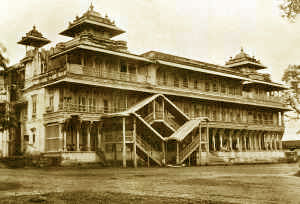 |
18th-century Juni Haveli (Old Palace) |
In the 18th century, Maharana Verisalji I, in alliance with the Maratha commander Damaji Jadhav, defeated a powerful army of the Mughal emperor Aurangzeb. With the Mughal power waning, Verisalji I stopped paying tribute in 1730, and his son Maharana Jeetsinhji recovered Nandod taluka and shifted the capital from Junaraj to Nandod, the new Rajpipla town in the plains on the Karjan river, a tributary of the Narmada.
Later rulers included Maharana Pratapsinhji Jitsinhji (1754–1764), Maharana Raisinhji Pratapsinhji (1764–1786), Maharana Ajabsinhji Pratapsinhji (1786–1803), Maharana Ramsinhji Ajabsinhji (1803–1810), Maharana Pratapsinhji Ramsinhji (1810–1815), Maharana Naharsinhji Ajabsinhji (1819–1821), and Maharana Verisalji Narsinhji (Verisalji II) (1821–1860).
After the decline of Mughal authority, Rajpipla found itself hemmed in by Baroda and compelled to pay an annual tribute of Rs. 50,000 to the Gaekwads. Under British paramountcy, Rajpipla became the largest and only first-class state in the Rewa Kantha Political Agency (“the banks of the Rewa, or Narmada”). During the 1857 uprising, Maharana Verisalji II led Rajpipla in rebellion and briefly freed the state from British control, but after the revolt was crushed and power passed to the Crown, he was forced to abdicate in 1860.
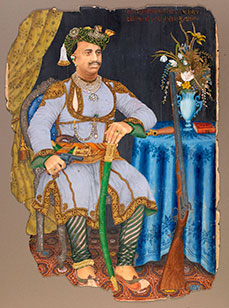
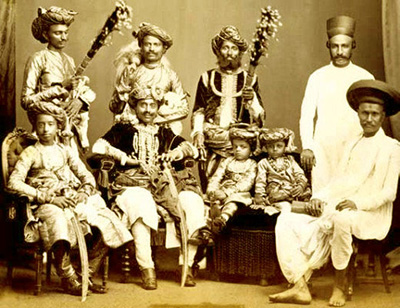
His son Gambhirsinhji (born December 1846) ascended the gadi on 17 November 1860 and ruled until 1897. During his reign, the road from Rajpipla to Ankleshwar was constructed, and the State Post emerged, though its earliest, purely official form likely dated from earlier times when dispatch of state documents was essential, sometimes using Gaekwar runners. The date when the State Post opened to the public is uncertain but appears to be in the late 1870s; Volume 6 of the Bombay Gazetteer on Rewa Kantha, published in February 1880, records that the post office at Nandod “is maintained by the Rajpipla Chief”. In 1889, on grounds of alleged mismanagement, the British appointed an administrator over the state. Maharana Gambhirsinhji died on 10 January 1897.
 |
 |
Maharana Gambhirsinhji of Rajpipla c. 1860 |
Maharana Gambhirsinhji Verisalji of Rajpipla with his eldest |
 |
Maharana Chhatrasinhji |
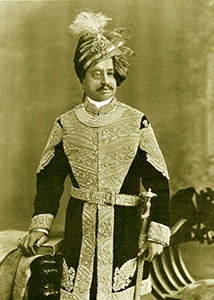
The modern golden era of Rajpipla began when Gambhirsinhji’s son, Maharana Chhatrasinhji (born 1862), succeeded in 1897. Educated at Rajkumar College, Rajkot, he was a progressive ruler under whose leadership Rajpipla advanced rapidly over the next half-century. He was conferred knighthood (KCIE) in recognition of his capable governance, which included the construction of a 60-mile (about 90 kilometres) railway line linking Rajpipla with Ankleshwar on the main Delhi–Ahmedabad–Bombay route, begun in his first year, and major famine relief measures between 1899 and 1902.
A motoring pioneer in India, Chhatrasinhji owned notable early cars such as a Wolseley 6 hp (1903–04), an Armstrong Siddeley 15 hp (1906), and a Clement-Bayard 16 hp. He ruled until his death on 26 September 1915.
Lt. Col. HH Maharana Sir Vijaysinhji Chhatrasinhji, KCSI, born 30 January 1890, succeeded his father on 26 September 1915 and was formally invested with full ruling powers on 10 December 1915. Educated at Rajkumar College, Rajkot, and the Imperial Cadet Corps in Dehradun, he received the hereditary title of Maharaja and his salute was raised from 11 to 13 guns. During World War I, Rajpipla supplied many recruits to the imperial war effort.
Maharaja Vijaysinhji implemented wide-ranging reforms, including free primary education, modest fees at high schools, scholarships, a main hospital, five dispensaries, and a veterinary hospital. He oversaw extensive public works, established a combined criminal and civil court, regularised land revenue, introduced pensions for public servants, and enhanced the pay of the police and military. He improved the quality of cotton, grains, and fruits grown in the state and undertook forward-looking town planning from 1927, requiring new buildings to leave a 3–4-foot (about 1 metre) setback for future road widening and integrating their designs with the surroundings.
He extended the road network and added the 40-mile (64 kilometres) Jhagadia–Netrang section to the Rajpipla State Railway. He also established a 19-mile (31 kilometres) steam railway and tramway linking Narmada-side towns with interior villages, along with a power house supplying electricity and water to Rajpipla town.
A keen horseman, Maharaja Vijaysinhji maintained one of the finest quality-focused racing stables in India and Britain. His horses captured several major races, including the first Indian Derby in 1919 (Tipster), the Irish Derby in 1926 and the Belgian Grand Prix in 1927 (both by Embargo), and the 1934 Epsom Derby (Windsor Lad); he remains the only Indian owner to have won the Epsom Derby.
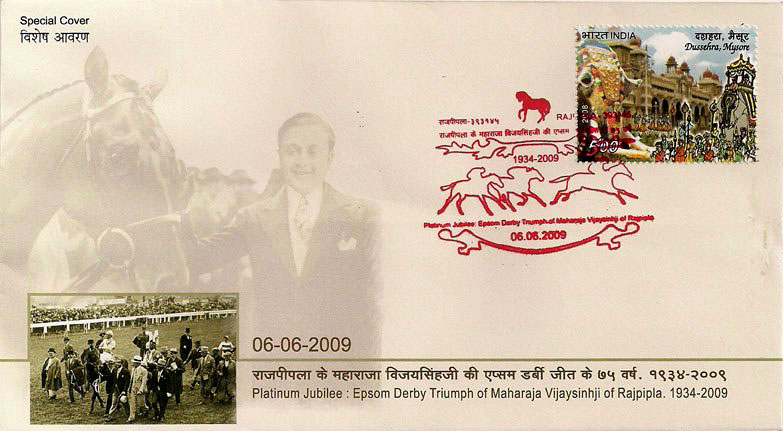 |
Special Cover issued to commemorate Platinum Jubilee of Epsom Derby Triumph of Maharaja Vijaysinhji of Rajpipla (1934-2009) at Rajpipla on 6th June 2009 |
Spending much of the summer racing season in England, he habitually returned to Rajpipla in winter and vigorously promoted sports such as cricket, football, and hockey, making games compulsory in state schools. He developed a polo ground and gymkhana in Rajpipla, and the royal family fielded a polo team composed of the Maharaja and his sons Yuvraj Rajendra Singhji, Maharajkumar Pramod Singhji, and Maharajkumar Indrajeet Singhji. A passionate automobile enthusiast like his father, Vijaysinhji is recorded as owning twelve Rolls‑Royce cars, from a 1913 Silver Ghost to a 1937 Phantom III, along with several other elite marques.
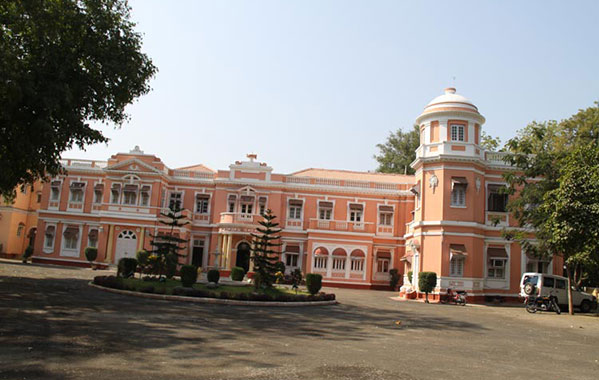
Vijayraj Palace, Rajpipla,built in 1915
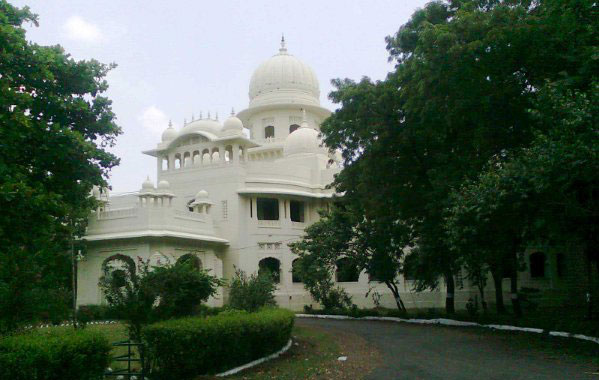
Indrajit - Padmini Mahal (Vadia Palace), Rajpipla, built in 1939
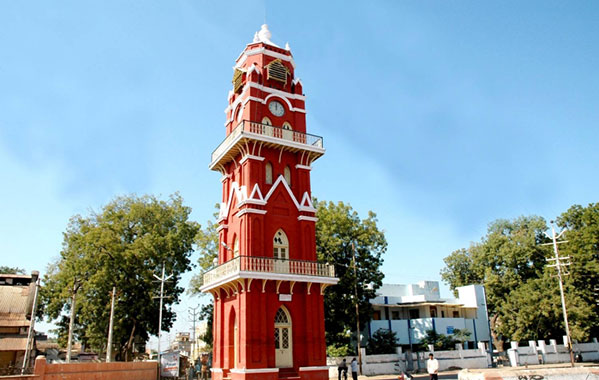
The Lal Tower (Red Clock Tower), Rajpipla, built in 1896
Maharaja Vijaysinhji developed an airstrip at Rajpipla where aircraft operated in the 1930s and 1940s. During World War II he donated three Spitfire fighter aircraft named “Rajpipla”, “Windsor Lad”, and “Embargo”, as well as a Hawker Hurricane named “Rajpipla II”. For his services he received the Knight Grand Cross of the Order of the British Empire (GBE).
Despite his long European sojourns and strong ties to the British Crown, Vijaysinhji fostered a nationalistic movement in Rajpipla in the 1940s under the influence of Mahatma Gandhi. Along with fellow Gohil–Sisodia Rajput rulers of Udaipur and Bhavnagar, he was among the earliest princes to hand over his state to democratic India in 1948, contributing Rs. 2,800,000 (2.8 million) from the state treasury. At his Bombay residence “Palm Beach” on Nepean Sea Road, he exhorted other rulers to surrender their states in the cause of national unity.
He also envisaged a dam across the Narmada to provide irrigation and generate electricity, a precursor to today’s Sardar Sarovar project, and was raising investment for it when Rajpipla merged with the Indian Union in 1948, ending approximately 600 years of Gohil rule. Maharaja Vijaysinhji died at his estate “The Manor” at Old Windsor in England on 29 April 1951 and was cremated at Rampura on the Narmada, about 18 kilometres from his former capital.
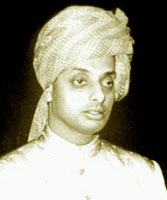 |
Maharaja Rajendra Singhji |
The title of Maharaja of Rajpipla passed to Vijaysinhji’s eldest son, Maharaja Rajendra Singhji, who made notable contributions to higher education in the region. He donated his father’s palatial European-style guest house for the cause of higher education; it became Maharaja Rajendra Singhji Arts and Science College. After his death in 1963, the title vested in Maharaja Raghubir Singhji, but the Indian princely order and official royal titles were abolished in 1971.
After Independence, Rajpipla State initially merged with Bombay State on 10 June 1948. In 1960, with the formation of Gujarat, its territories were regrouped into the new state. Rajpipla remained part of Bharuch (old Broach) district until 2 October 1997.
Most of the former Rajpipla State now forms Narmada district, with Rajpipla town as district headquarters; the district comprises Tilakwada taluka (formerly in Vadodara district) and Nandod, Dediyapada, and Sagbara talukas (previously in Bharuch district). Some portions of the old princely state still lie within present-day Vadodara and Bharuch districts.
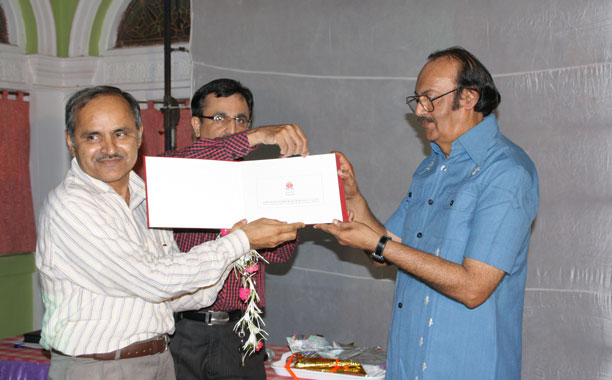
Myself with Maharaja Raghubir Singhji and Shri A. K. A. Joshi, Former Postmaster General, Vadodara Region, at the release of the Special Cover on the Epsom Derby in Rajpipla. |
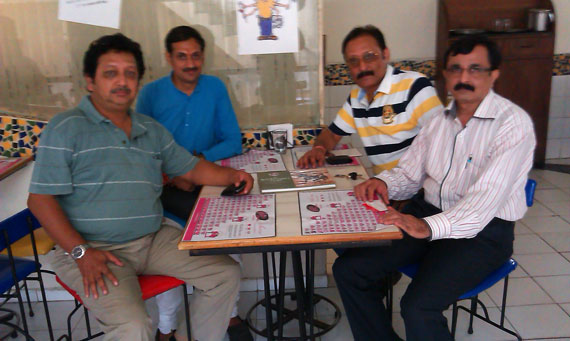
Myself with members of the Royal Family of Rajpipla—from left: Shri Indravadan Singhji, Prince Manvendra Singhji, and Shri Indra Vikram Singhji. |
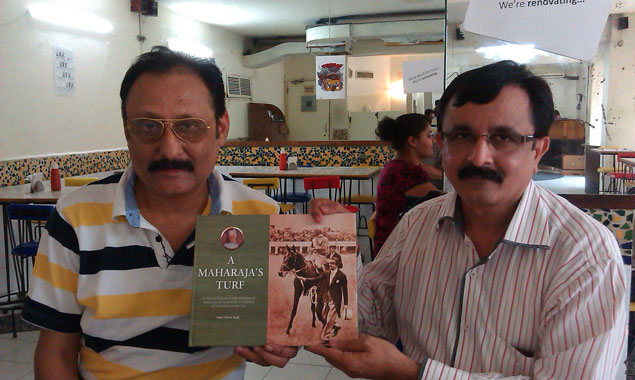
Shri Indra Vikram Singhji presenting me with his book A Maharaja's Turf. |
Gohil Rajput Dynasty of Rajpipla - Indra Vikram Singh
Rajpipla Princely State - Abhinay Rathore
Counter View - Dr Hari Desai
Rajpipla Brief History - Christopher Buyers