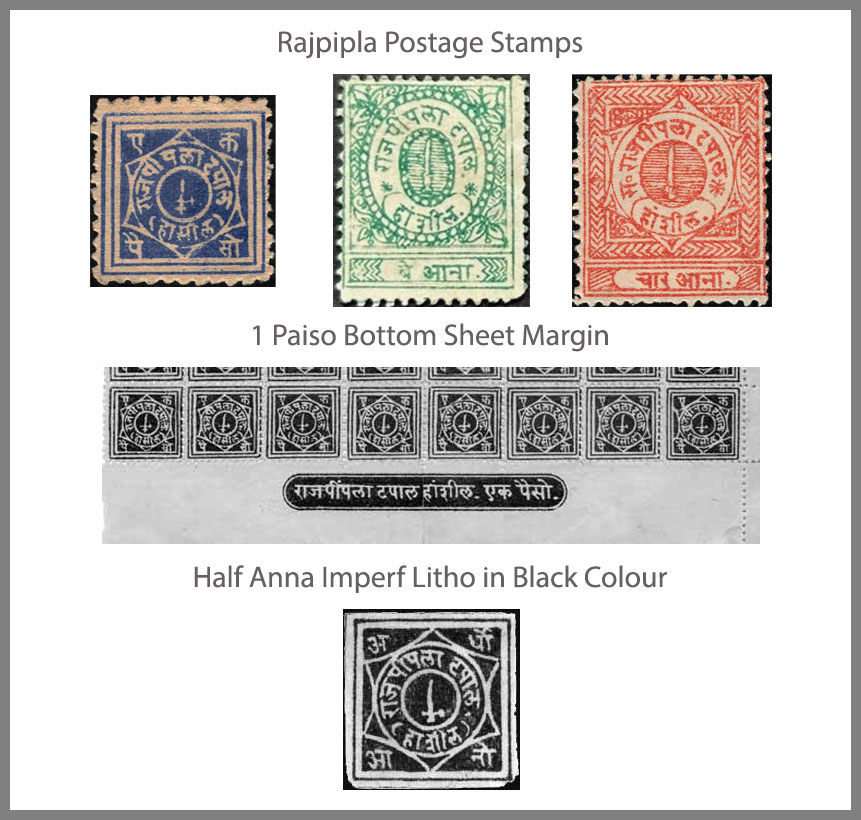
The first adhesive postage stamp of Rajpipla State, the 1 paisa value, appeared in European stamp magazines in November 1880, reported as issued on 1 June that year. A few months later, the 2 annas and 4 annas values followed (Images below). No further adhesives were produced, and by 1886, the State Post had merged into the Indian postal system.
The 1 paisa stamp was lithographed in sheets of 64 (8x8), featuring a square design with a central sword. The inscription reads RÀJPIPLÀ TAPÀL [post] in Marathi script - distinct from the Gujarati on the letter sheets - above HÀNSHÌL (tax or profit) in brackets, with the value E-K PAI-SO divided across the four corners.
The bottom sheet margin includes a matching tablet (Image below), and complete sheets show an outer frame at top and right (This is absent from the top margin of the sheet in the Tapling Collection in the British Library, but may have been trimmed off).
Major Evans noted in Gibbons Stamp Weekly that most printing flaws on the 1 paisa are inconstant, though vertical perforations vary.
Haverbeck suggested the frame lines around each stamp were drawn individually post-litho transfer. Peter Röver holds three sheets—only one gummed—each with differences in the right-hand vertical perforations: one extends fully to the bottom margin; another has one hole below the last row; the third shows two holes below, plus one extension in the prior line. One sheet is perf 11½, unlike the true 11 of the others.
The higher values, issued in taller formats in sheets of 20 (4 rows of 5), differ markedly in style. Inscriptions mirror those of the low values, with the 4 annas adding "SAN" (Sansthan or State) before "RAJPIPLA." Frame lines appear on the 2 annas at top and left, and on the 4 annas at bottom and left.
Haverbeck records that 1880 reports also mentioned a 2 paisa value; however, my article in India Post 151 (February 2002) confirmed from official Rajpipla State correspondence to Baroda State that the half anna [=2 paisa] and 1 anna were in use, though no specimens of these accompanied the others.
Derek Bates owns a lithographed half anna stamp, printed in black on thin wove paper. Imperforate and trimmed close—losing most of the outer frame—it closely resembles the 1 paisa design but bears "A-RDHO / À-NO" (Half Anna) inscriptions in the corners, with precise Marathi lettering.(Image below) This may be the "proof in black" from the 1965 R. F. Stoney sale.
Haverbeck referenced Le Timbre-Poste (May 1884), which reported an 8 annas value in the 2 annas design but 4 annas color—unseen today. A document I discovered from 1883 confirms an 8 annas stamp in actual use. If this ever existed the main use might have been the fee on Money Orders, and the forms would not of course survive.
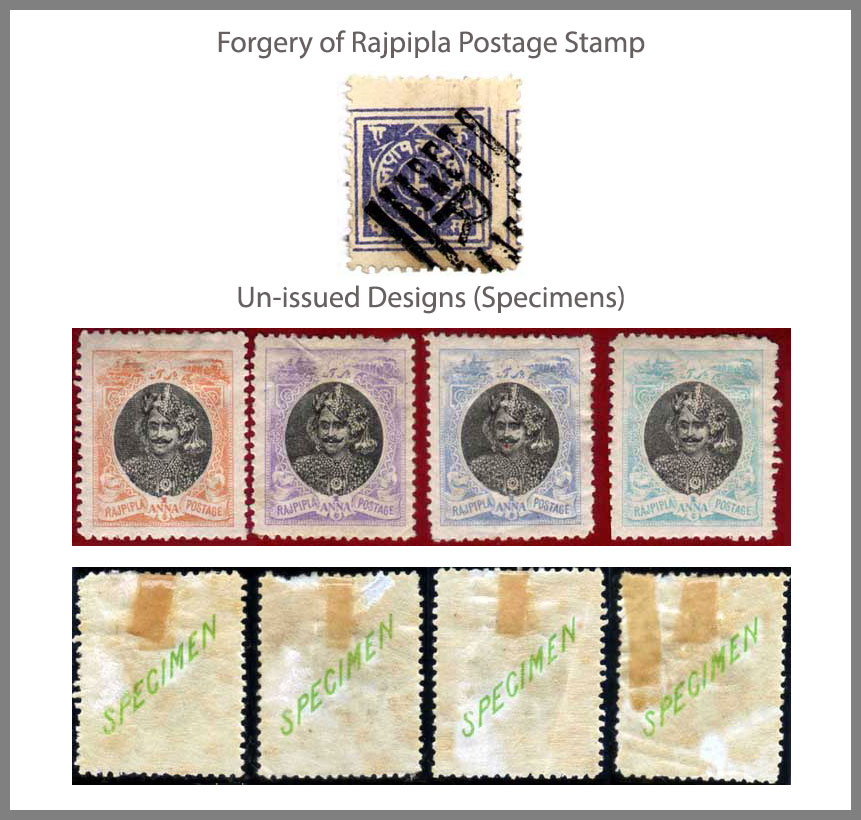
Forgeries: Crude forgeries exist of the 1p and 2as. adhesives, often with faked postmarks. The 1p forgery lacks perforation, while the 2as. forgery shows perf 11 instead of the genuine gauge 12½. Further forgeries of the 1p include two reasonably accurate copies with a constant break at the right of the top outer frame and coarser lettering.
These measure about 23 x 25mm—larger than genuine due to excessively wide margins—and feature a rectangular seven-bar obliterator with an "R" in the center (in English, akin to Renouf type 8, unlike the genuine Nagri script).
Imperf single-die forgeries of the 2as. and 4as. appear on toned wove paper, easily distinguishable. One 4as. example from the same die is roughly perf 11 with a trace of obliteration. These likely represent modern productions.
Unissued: Unissued designs include a series of six high-standard lithographed bicolour essays inscribed "RAJPIPLA 1 ANNA POSTAGE" in English only (c.1900), featuring a black portrait of the Raja, perf 11½, and varying frame colors. Each bears a green underprint "SPECIMAN," with some showing part gum. The frame incorporates a steamship and steam train in the upper corners. Two similar stamps appeared in the second Couvreur sale (R. Lowe, Sept. 1981) and were discussed in the Philatelic Journal of India (Sept. 1977). The portrait resembles—but flatters—a younger Chhatra Singhji, as seen on his 1903 revenue stamp.
Given Rajpipla's merger in 1886 and its landlocked status, post-merger revival seems inconceivable. English-only designs with steamship imagery (despite a sailing ship in the state arms) prove improbable. These essays likely originated as speculative printer productions or commercial samples, akin to the "Bhopal" essays, possibly with inadequate market research.
1 p. Blue. Perf 11, 2 A. Green. Perf 12½, 4 A. Brown. Perf 12½.
Lithograph, Gummed/ Ungummed
1 Paiso Bottom Sheet Margin
Half Anna Imperf Litho in Black Colour
Forgery of the 1p. Stamp with
Postmark.
Unissued Designs: Six examples of litho in different frame colours,each with green underprint SPECIMEN