
 |
Covers bearing Rajpipla postmarks remain scarce. A Harmers of London sale catalogue from 10 February 2000 noted "possibly less than ten recorded," but sixteen have now been seen or reported, plus two used stationery items—though the same examples recur in sales.
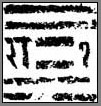
Four covers and one letter-sheets are known with datestamp '(RÀJPÌPLÀ POST / NÀ (N)DOD' ; the letter-sheet dates to 4 July 1879, confirming use before adhesives appeared.
One incomplete strike, dated "A (August). 14" , appears on an Indian ½ anna blue stamped envelope (1877 issue), posted in Bombay on 12 August; no year is shown. Envelope is addressed to "Sheth Bhimjibhai of Nandod and sent via Chandod. This is the sole known inward mail item; there is no indication of any charge being collected. My article in India Post 151 (February 2002) indicates a ¼ anna (1 paisa) fee in 1882 if prepaid in India. It is possible that this is from the pre-adhesive period and that the datestamp was applied on payment of the local charge on delivery at Nandod.
Derek Bates showed an example of partial strike dated "JU 12" (July) on the back of a ½ anna envelope fronted by a State 1 paisa with R-1 obliterator; routed Nandod–Chandod–Bombay, wihtout year to David Padgham.
Similar cover to Bombay with Indian adhesive added was offered at Spinks during April 2000; and the detached back of an envelope reported by Mr. J Veldman with 1p adhesive showing the normal obliterator, the large datestamp reading AP.29, also CHANDOD AP.30 and CALCUTTA DELY. MAY 5 - but still no evidence of year. This letter is the only item known to have been addressed to Calcutta.
Nagri Small Datestamp (NA(N)DOD / [month/day]) replaced the large Marathi type struck away from adhesives (obliterated R-1); later over an adhesive on a Jaipur cover with Abu transit mark 23 Sep.85—a "combination" cover sold at Christies (Dec 1995, est. £600) and Harmers (Feb 2000, £2415 vs. est. £500). A large piece at one time offered retail by Gibbons shows a State adhesive alongside an Indian 1/2a., both having the State R-1 obliterator, the only known use of it on an Indian adhesive.
The standard obliterator is a six-barred type (like Indian "type 17") with "R-1" in Nagri between bars. One example shows it on a 1 paisa on the back of a 1877 ½a envelope, with small datestamp and Chandod cds where mails were exchanged; addressed to "Bharuchwala Book Seller Seeramjibhai care of Bookseller Jestharam Makanji, at Mumbadevi"—to Bombay. A Harmers cover to Baroda (readdressed Bombay), described as 1880 (not visible), and year type was not normally used in that year.
David Padgham's cover with damaged adhesive, (BPA cert. 1973) matches Haverbeck's Collectors Club Philatelist (Nov 1957), sold at Gibbons (14 Dec 1979, est. £225), and later ISC room auction. An RPS-certified cover very similar this but with undamaged adhesive; was on L.E. Dawson sale (1967, lot 543).
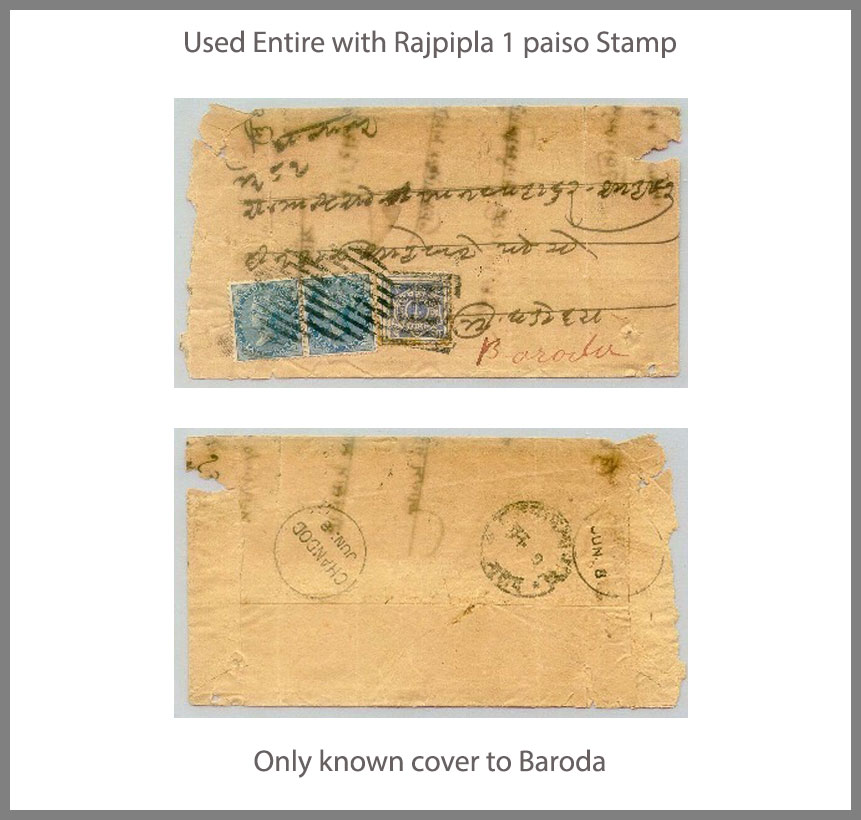
Few years back I acquired a cover, which unusually has the 1 paiso adhesive, showing the usual obliterator, affixed on the address side alongside the pair of Indian 1/2a. adhesives, which themselves have the round barred obliterator B widely used in the Bombay Circle. This is the only cover known to Baroda, and is also unusual in being a folded letter rather than an Indian stationery cover. No datestamp is visible.
Only two postcards are known, both Indian QV 1/4a stationery cards; one with the CHANDOD cds of -.Sept. 84, and a State 1 paiso showing the R-1 obliterator which is also tied by an Indian datestamp of KAPADVANJ, a railhead in the north of Gujrat. This was also offered in the above Spinks sale. The other, reported recently by Mr. J Veldman, is very similar but the CHANDOD cds is 22 JAN. 84 and the destination is Bombay. This is from a librarian in the Maharana's Library to the editor of a magazine published in Bombay advising that Rs.6 had been sent by Money Order as a two-year subscription. I had reported in India Post 151 (February 2002) that the Indian Money Order system was available through the State post.
A single 1 paiso adhesive is recorded by Haverbeck with a seal obliterator reading NANDOD in English, but this may be the bag seal which would have been issued when this office became part of the Indian system in 1886, and struck by favour for a philatelist. The 2as. and 4 as. adhesives are unrecorded on cover, other than the 2 as. affixed to the letter sheet described above. David Padgham I have both values on small pieces with the R-1 obliterator probably applied by favour, and the Tapling collection has very similar pieces.
The only other type of obliteration reported is from Derek Bates, on a 1 paiso off cover with two part strikes of a purple circular cachet with perhaps vernacular characters. This looks like an attempt to create desirable 'used' from mint - all too frequent an occurrence. Bearing in mind the high premium for used over mint, no Rajpipla stamp should be accepted as genuinely used unless it shows a clear strike of the obliterator or the small datestamp.
Used Entire from Rajpipla with 1 paiso adhesive and pair of British India 1/2a. adhesives with usual obliterator on reverse. The only cover known to Baroda, and is also unusual in being a folded letter rather than an Indian stationery cover.
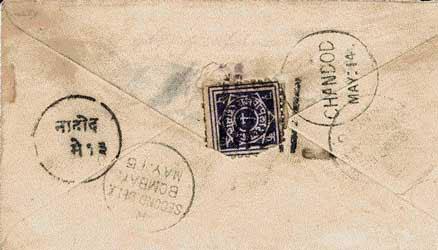
1 paisa Rajpipla adhesive on the reverse of an Indian ½a. stamped envelope (1877 type), cancelled by the small Nandod datestamp and the Indian PO datestamp of CHANDOD, where mails were exchanged.
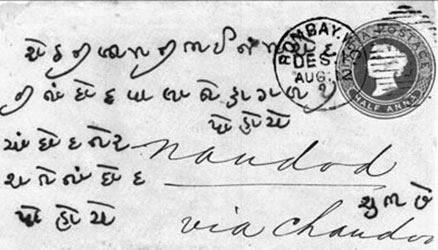
Indian 1/2 anna blue stamped envelope of the type first issued in 1877, addressed to Nandod (Rajpipla) with Circular Delivery mark of Rajpipla (Nandod) in Devnagri script on reverse.
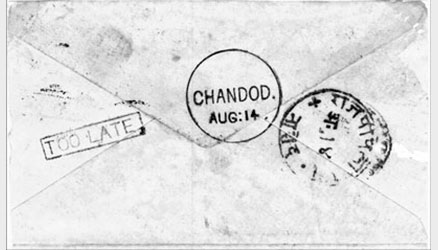
Indian 1/2 anna blue stamped envelope of the type first issued in 1877, addressed to Nandod (Rajpipla) with Circular Delivery mark of Rajpipla (Nandod) in Devnagri script on reverse.