
Before adhesive stamps of Rajpipla were issued, postal stationery letter sheets appeared, but several peculiar features indicate that they saw little use. The sheets were printed on thin paper watermarked “DORLING & GREGORY” in two slightly different-sized impressions, probably supplied by a British firm. Each sheet measured about 400 x 300 mm, was folded like large notepaper, and bore an embossing at top left with the year 1874 in an oval wreathed frame, applied after folding so that it appears in reverse on the left half when unfolded. The embossing date may not represent the year of printing, as paper stocks could have been held for some years before use, and some sheets were printed on the inner side of the folded paper, which produces a reversed watermark and different position of the embossing.
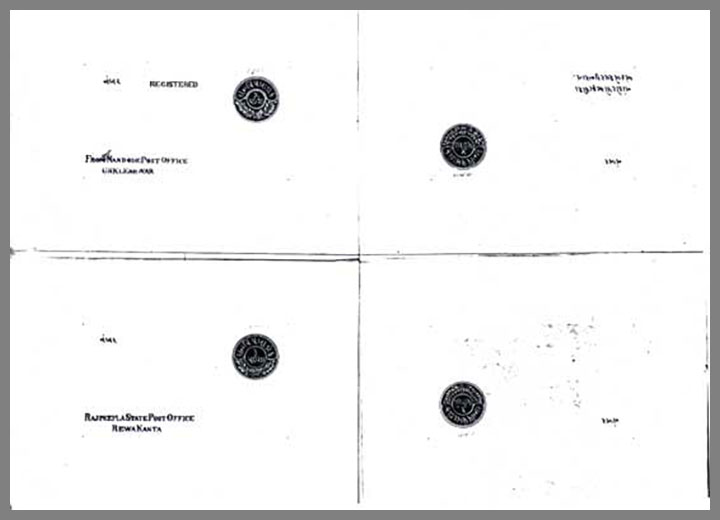
All four denominations were printed on a single unfolded sheet from one stone, with uninterrupted dividing lines crossing at the centre to indicate where the sheet was to be cut. One half of the sheet contained the 2 paisa and 3 paisa impressions, while the opposite half contained inverted 1 paiso and 4 paisa impressions, ensuring equal quantities of all four values even though catalogues long treated the 1 paiso as scarcer. The set of 1, 2, 3 and 4 paisa is illogical in that 4 paisa would normally be expressed as 1 anna, and these values do not match either the adhesive values or the postal rates recorded for 1882, suggesting that the 1 paiso should have been the minimum letter rate and needed in much larger quantities than the others.
An uncut sheet of four indicates that the printing may have used four stones locked together in a forme, though the continuous dividing lines argue against them being merely the physical edges of the stones or simple printer’s rules. A mint 2 paisa sheet on yellow paper, first reported by Evans in 1902 and now in Ajeet Singhee’s collection, is likely a proof impression, but the material as a whole appears to have been officially issued in the State, albeit little used. The range of denominations including “4 paisa” remains difficult to explain on postal logic.
The appearance of the letter sheets and later adhesives coincided with a period of misrule under Maharana Gambhirsinhji (often written Ganbhir Singhji), during which joint British–native administration was imposed in 1884 and replaced by full British administration in 1887, soon after the closure of the State posts, continuing until the ruler’s death in 1897. A State printing press was established only in 1883, meaning the postal paper cannot have been printed locally and must have been produced outside the State, probably under an administration that had little understanding of actual postal needs and may even have been influenced by stamp dealers.
The higher values, issued in taller formats in sheets of 20 (4 rows of 5), differ markedly in style. Inscriptions mirror those of the low values, with the 4 annas adding "SAN" (Sansthan or State) before "RAJPIPLA." Frame lines appear on the 2 annas at top and left, and on the 4 annas at bottom and left.
The impressed circular design places the value at the centre, with “RÀJPIPLÀ DÀK” in Gujarati at the top and crossed branches below.
The I-vowel sign in “RAJPIPLA” is written with a short vowel, an error associated with less-educated writers, whereas the adhesive stamps show the correct long-vowel form; the adhesives also use the term “TAPÀL” instead of “DÀK” for “post”.
Early philatelic forgeries exist at least for the 3 paisa value, often as cut-outs, with smaller and cruder lettering and markedly different crossed branches; one forged piece carries a smudged seal-like “postmark” and is printed on locally obtained, overly thick paper bearing Gujarati handwriting on the back to lend an appearance of authenticity.
In addition to the impressed stamp, each value bears further text on the front of the sheet, partly in Gujarati and partly in English.
1 paiso: only “NAMBAR” (“number”) in Gujarati, a word that also appears on the other values.
2 paisa: “NAMBAR” followed by “REGISTERED” in English and, below, “FROM NANDODE POST OFFICE / UNKLESHWAR”.
3 paisa: “RAJPEEPLA STATE POST OFFICE / REWA KANTA” in two lines of English, with “REWA KANTA” also being a misspelling.
4 paisa: entirely in Gujarati, reading “NANDOD POST HÀPÌSH [office] / ANKLESHWAR GUJRÀT”.
Nandod was the capital and head post office, while Unkleshwar (Ankleshwar) lies in British territory and must indicate the exchange office for mails beyond the State, which should then bear Indian postage as well. Rewa Kanta refers to the larger district under the Political Agent, and the presence of alternative address indications on different values would have been a source of confusion. The “registered” inscription appearing only on the 2 paisa sheet is anomalous, since the registered sheet would more logically have been the highest value and registration fees were much higher than 2 paisa; moreover, the stationery does not appear to have been intended for uprating with adhesives, which were probably issued later.
These features suggest that the letter sheets may have been essays rather than fully integrated postal stationery, possibly produced in Bombay, where firms such as Thacker, Spink handled similar work, either on commission from the State or speculatively in the hope of selling a stock. Mint examples are relatively common, and it is plausible that remainder sheets of four were cut up and sold to stamp dealers in such a way as to promote the 1 paiso value as “scarce”. One 4 paisa sheet bears an additional private embossing “ALFRED SMITH & SON, LONDON”, indicating later philatelic handling by a London firm.
Letter sheets were first reported in The Philatelic Record in April 1879. Very few genuinely used examples are known; two items that have appeared repeatedly bear bogus addresses in Urdu and fabricated “postmarks”, one an unframed oval in Gujarati reading “Made in Germany” and the other a small Persian-script cachet unlikely to have been used in a Hindu State. Both were illustrated by Haverbeck in the Collectors Club Philatelist of November 1957, and one 2 paisa example later appeared in the first Couvreur sale in March 1981 and is illustrated in Deschl’s catalogue, alongside an equally doubtful 3 paisa “usage”.
More convincing examples have since been reported. A used 2 paisa sheet offered by a U.K. dealer around 2000 carried a note that it was “one of only two known”; it shows a partial strike of the standard small Nandod datestamp and bears a 2 annas adhesive, the only recorded on-cover use of that adhesive. As the sheet is inscribed “REGISTERED”, it may be inferred that the adhesive paid the registration fee, even though no register number was entered; the item is locally addressed to the village Ratanpur near Jhagadia, about 30 km from Nandod, and represents the only reported example of purely internal mail.
Initially there was only one post office, at Nandod, which communicated solely with British India, though by the time of postal unity in 1886 there were additional offices at Jhagadia, Bhalod and Vadia. The Ratanpur sheet is surprisingly addressed in Urdu and then translated into local Gujarati, and both the adhesive and the impressed stamp show two faint strikes of a lozenge of twelve bars, about 21 x 28 mm, resembling the early barred obliterations of Hyderabad; while the cancel may not be wholly authentic, the item appears to represent genuine postal use of the letter sheet, with the possibility that the adhesive and cancel were applied later.
A 1 paiso sheet is recorded used to London, bearing Indian 4 annas and 1 anna adhesives on the reverse and a London arrival mark dated 1 August 1879. On this entire the impressed stamp is not cancelled, but the back shows the large Nagari (Marathi) circular datestamp with a CHANDOD JUL 4 transit of the Indian exchange office. The cover is addressed to “Mr. Pemberton Willson & Co., Philatelical Publishers”, linking it to E. L. Pemberton’s firm, which, after his death, was carried on by A. H. Wilson, founder in February 1879 of The Philatelic Record that published the initial notice of the letter sheets that April, implying that specimens were solicited for philatelic purposes.
Stamped envelopes in the same basic design and in denominations of 2, 3 and 4 paisa have been recorded and are often assigned an issue date of 1886, though this date lacks firm documentary support. These envelopes were unknown to early specialists such as Major Evans, who did not mention them in his 1910 study in Gibbons Stamp Weekly, and modern opinion is that the envelopes were produced from the same lithographic stone as the letter sheets, or from transfers taken from it.
A known unused 3 paisa envelope shows that the envelope was not created by cutting down a letter sheet; the bottom flap has a well-formed knife and carries a colourless embossed tress similar to Hyderabad type I as described by Deschl, circular with crossed branches reminiscent of the sheet design. This has prompted comparison with contemporary Hyderabad “stamped to order” envelopes supplied for dealers, raising the possibility that a similar arrangement was made with Rajpipla; if the envelopes were printed in 1886, they would fall in the period of joint British administration, which makes such dealer-driven experimentation somewhat less likely, and a slightly earlier date during the corruption era appears more consistent with their elusive status and absence from Evans’s 1910 account.
Uncut sheet of four Letter Sheets
1 paiso - only 'NAMBAR' (number) in Gujarati (this is also on all the other values)
2 paisa - as above followed by REGISTERED in English, and below - FROM NANDODE POST OFFICE / UNKLESHWAR.
3 paisa - RAJPEEPLA STATE POST OFFICE / REWA KANTA in English in two lines
4 paisa - entirely in Gujarati: NANDOD POST HÀPÌSH [office] / ANKLESHWAR GUJRÀT.
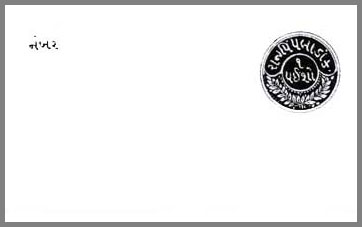
Only 'NAMBAR' (number) in Gujarati (this is also on all the other values)
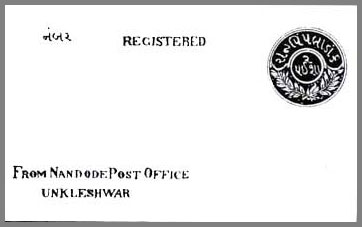
Same as 1 paiso, followed by REGISTERED in English, and below - FROM NANDODE POST OFFICE / UNKLESHWAR.
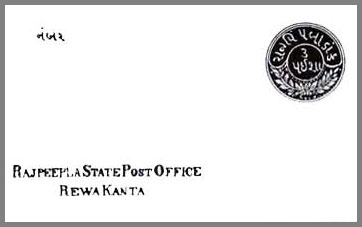
Same as 2 paisa without REGISTERED. RAJPEEPLA STATE POST OFFICE / REWA KANTA in English in two lines
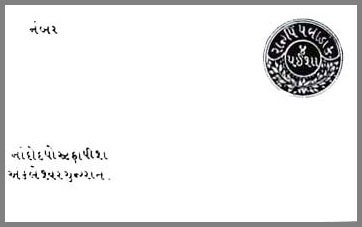
Entirely in Gujarati: NANDOD POST HÀPÌSH [office] / ANKLESHWAR GUJRÀT.
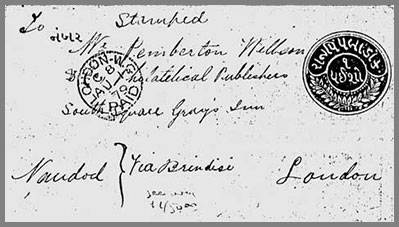
One paisa used example of Letter Sheet, mailed to London, with Indian 4as. and 1a. adhesives on the back.
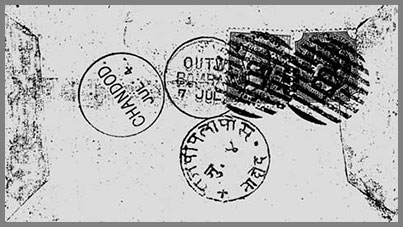
One paisa used example of Letter Sheet, mailed to London, with Indian 4as. and 1a. adhesives on the back and a London arrival mark 1 August 1879 and Marathi Circular Date Stamp of Rajpipla on the back, with CHANDOD JUL.4 of the Indian office of exchange.
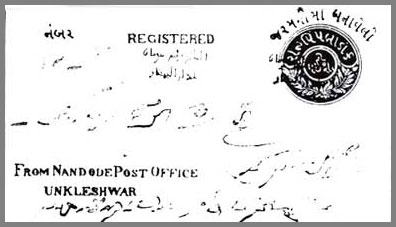
Two paisa used example of Letter Sheet.
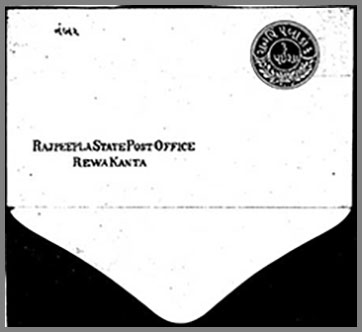
Example of 3 Paisa Envelope with flap at bottom, RAJPEEPLA STATE POST OFFICE / REWA KANTA in English in two lines.